
Start structural pruning in late autumn to early spring during dormancy, when energy is stored in the roots, wounds heal cleanly as growth resumes, and branch structure is clearly visible without foliage.
Structural pruning shapes the entire future of your tree. You do more than tidy growth; you decide which branches stay, which go, and how the trunk line and overall bonsai style will develop for years to come. This is the stage where design becomes deliberate.
In bonsai, structural pruning means removing larger, unwanted branches to create the tree’s basic shape and improve balance, health, and long-term growth. Unlike routine maintenance, which refines the outline, structural work changes the framework; cuts made with purpose, informed by how trees grow and how apical dominance pushes energy to the top and outer edges.
When you understand timing, species needs, and safe limits, you protect your bonsai and support strong recovery. With the right tools and careful cuts, you reduce scarring and guide growth where you want it, improving both structure and bonsai aesthetics.
Beginners making their first structural cuts:
Outdoor deciduous species growers (Maple, Elm, Hornbeam, Beech):
Outdoor conifer growers (Juniper, Pine, Larch):
Indoor tropical species growers (Ficus, Carmona, Jade):
Experienced growers planning a major structural redesign:

Structural pruning means removing or shortening primary branches to set the tree’s long-term shape. You decide the trunk line, main branch placement, and overall silhouette before refining smaller growth.
This is not light trimming. You make deliberate cuts that change the framework of the tree and guide how it will develop over years, not weeks.
You use structural pruning to build the bonsai’s basic design. You remove branches that do not fit the intended shape or movement.
Typical structural bonsai branch pruning includes:
These cuts often involve older, woody growth. They change the tree’s structure in a visible way.
Maintenance pruning, by contrast, controls size and refines detail. You pinch or trim soft shoots during the growing season to keep the outline neat.
For example:
Both are essential bonsai pruning techniques. Structural work sets the framework. Maintenance work preserves and refines it.
With structural pruning bonsai, timing often matters more than how cleanly you hold the scissors.
When you remove major branches, you reduce the tree’s leaf mass and stored energy. If you prune at the wrong time, you weaken the tree and slow recovery.
In the UK climate, you generally:
Trees heal wounds and push new buds when energy reserves are high. Pruning during dormancy or just before growth allows the tree to redirect stored resources into new structure.
Even perfect bonsai pruning techniques cannot compensate for poor timing. Respect the seasonal growth cycle, and your structural cuts will support healthy, controlled development.
In the UK, the best time to prune bonsai structurally depends on dormancy, sap flow, and species type. Most heavy work fits into the late autumn to early spring window, with careful adjustments in early spring and limited work in summer.
For most UK growers, bonsai dormant pruning runs from November through to early March. This is the safest and most reliable window for major structural changes.
During dormancy, deciduous trees such as maple, elm, beech, and hornbeam store energy in their roots and trunk. They have no leaves to support, so removing large branches causes less immediate stress. You can clearly see the branch structure, which makes design decisions easier and more accurate.
Key advantages of dormant pruning:
In the UK climate, aim to complete heavy structural work before buds swell, usually by late February or early March in southern areas and slightly later in colder regions. Avoid pruning during hard frost, as freshly cut tissue can suffer damage.
For deciduous species, this period is widely regarded as the best time to prune bonsai when significant branch removal is required.
From February to April, sap begins to rise and buds swell. This is another strong window for structural pruning, especially just as buds show green but before full leaf-out.
At this stage, your tree enters active growth. Rising sap and rapid cell division help wounds close faster. Callus forms quickly, which improves healing and reduces long-term scarring.
However, timing matters:
If you’re wondering when to prune bonsai for fastest recovery, early spring offers strong healing potential. In much of England, this means mid to late March. In Scotland or colder inland areas, it may shift into early April.
Monitor your tree, not just the calendar. Bud movement is your signal.
You can, but only with limits.
June falls within the active growing period. Trees focus on extending shoots and supporting full foliage. Large cuts at this time force the tree to redirect energy while also coping with warm weather and longer daylight hours.
If you prune bonsai in summer, keep it light:
For UK bonsai June care, prioritise maintenance pruning, wiring adjustments, and health checks instead of heavy structural work. Major cuts in June can lead to stress, sun scorch on newly exposed bark, and weaker regrowth.
In short, reserve big structural changes for dormant or very early spring periods. Use June for refinement, not redesign.
You cannot prune every bonsai the same way. Species type determines timing, cut placement, and recovery speed, and getting this right prevents dieback, excessive sap loss, and long‑term design flaws.
With deciduous bonsai pruning, timing is critical. The safest window for major structural cuts is:
At this stage, you see the branch structure clearly and reduce stress on the tree.
For maple bonsai pruning, avoid heavy cuts in early spring. Maples bleed sap heavily when pruned as buds break, which weakens the tree. Instead, complete major branch removal while fully dormant.
Key structural points:
Oaks tolerate firm cuts but heal slowly. Beeches respond well yet show scars easily, so plan major removals carefully.
Common mistakes:
Conifers follow different rules. In general, structural work happens in late summer to early autumn, when growth slows but energy reserves remain strong.
If you wonder when to prune juniper bonsai, choose late summer. Junipers do not backbud on old wood reliably, so never cut beyond live foliage unless you intend to create deadwood.
With pine bonsai structural pruning, remove unwanted branches in late summer or early autumn. Avoid heavy structural cuts in spring candle growth. Pines rely on needle mass to stay strong.
Important rules:
Larch bonsai pruning UK growers must remember that larch is deciduous. Treat it more like maple than pine. Structural pruning works best in late autumn after needle drop or late winter before bud break.
Common mistakes:
Tropical species behave differently. In the UK, you can carry out ficus bonsai pruning and other structural work year‑round if you keep the tree indoors in stable warmth.
That said, the best recovery occurs from spring to early autumn during active growth.
Species notes:
Structural goals stay the same: remove heavy, poorly placed branches and establish primary lines early.
Common mistakes:
Match your timing to growth cycles, and your tree will recover faster and hold its new structure with less stress.
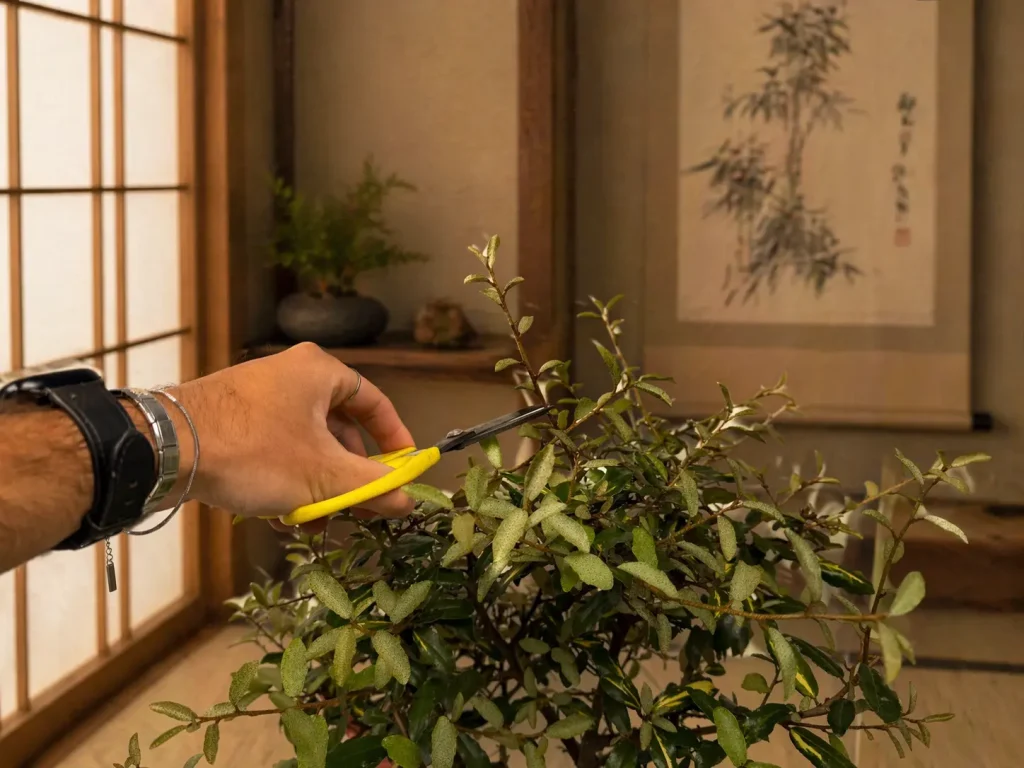
You can usually tell when your tree needs more than light trimming by looking at proportion, branch placement, and silhouette. If the structure feels crowded, unbalanced, or far from the original design, structural work is likely overdue.
Stand back and study your main branches, not the small shoots. Structural pruning bonsai focuses on these primary limbs because they define the tree’s framework.
Look for branches that:
Heavy pruning should always target structure, not random greenery.
If a lower branch has grown almost as thick as the trunk section above it, the scale is off. This often happens when apical dominance pushes strong growth into one limb. In this case, bonsai trunk pruning or removal of that branch may restore taper and visual balance.
Also check extension length. If a primary branch now stretches well past the intended pad and cannot be corrected with simple shortening, structural intervention is more appropriate than routine maintenance.
Move your eye along the trunk line and examine where branches emerge. Two branches occupying the same visual plane weaken depth and clarity.
Watch for:
When you leave these in place, they thicken together. Over time, they create swelling and inverse taper at the junction. That makes future structural pruning bonsai more drastic and harder to execute cleanly.
If two branches compete for dominance, choose the one that best supports your design. Remove or significantly shorten the other. This is often part of heavy pruning bonsai, especially in early development.
Clear branch hierarchy strengthens the tree visually and physically. Each branch should have space and purpose.
Step back several feet and look at the entire outline. Does the tree still match its original style?
For example:
If the apex has drifted off-centre, lower branches have become too dominant, or the cascade line has filled in upward, the design has shifted. At this stage, trimming tips will not fix the issue.
Redirecting the apex or removing a major limb may be needed to restore compositional balance. When the silhouette looks blurred instead of defined, structural work is overdue.
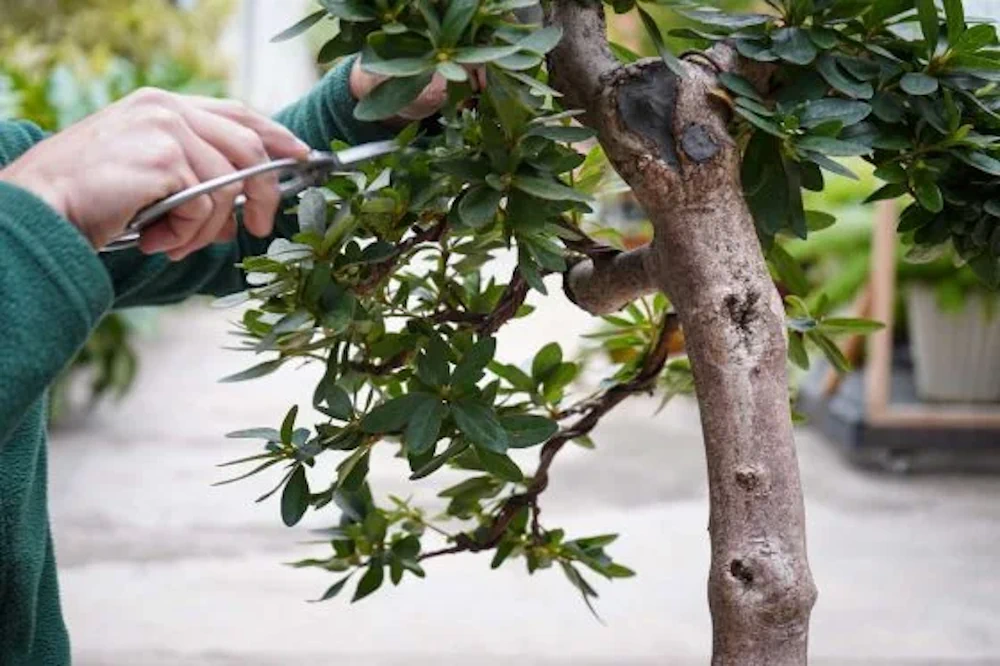
Structural pruning shapes the basic framework of your tree and often involves removing thick or poorly placed branches. You need the right tools, precise cuts, and careful aftercare to help the tree recover well.
Start with proper bonsai tools. Clean, sharp blades make smooth cuts that heal faster and reduce the risk of disease.
Essential tools:
Always disinfect your tools before you begin. Use alcohol or a suitable sterilising solution.
Blunt tools crush fibres instead of slicing them. That slows healing and increases the chance of infection. Clean cuts are not cosmetic; they directly affect how well your bonsai recovers.
When learning how to prune bonsai at a structural level, tools matter as much as technique.
Decide which branches must go before you begin. Structural pruning is irreversible, so remove one branch at a time and reassess the silhouette after each cut.
For thicker branches:
Use bonsai concave cutters to create a shallow hollow. This concave cut encourages faster callus formation and reduces visible scarring over time.
If the branch is heavy, reduce its length first, then make the final cut. This prevents tearing bark down the trunk.
As a safe limit, aim to remove no more than roughly a third of the tree’s total foliage in a single session. After any significant cut, apply bonsai wound sealant or cut paste immediately. This protects exposed tissue from pests and fungal infection and supports steady healing. Large wounds benefit most from sealing, especially during active growth.
Structural pruning removes a large portion of foliage. A healthy tree can usually tolerate up to about one-third of its foliage being removed, but recovery still requires care.
Place your bonsai in a sheltered spot with bright, indirect light for a couple of weeks. Avoid strong midday sun and heavy wind during this period.
Adjust watering carefully. Do not let the soil dry out, but avoid waterlogging. Slightly reduce watering for a few days if you removed substantial growth, as the tree’s demand will drop.
Over the following weeks:
Delay other major work, such as root pruning or repotting, until the tree has fully recovered. Focus on stability and steady growth while it rebuilds strength.
Even with good intentions, these are the errors that catch growers out most often:
The right tools let you remove heavy branches cleanly and protect the tree while it heals. Quality cutters and reliable wound care products make structural pruning safer, more precise, and easier to manage.
Structural pruning requires more than standard garden secateurs; you need specialist tools designed for clean, controlled cuts on woody bonsai material.
Two tools stand out for heavy branch work:
Fine scissors remain useful for smaller twig work, but for structural changes, concave and knob cutters do most of the heavy lifting.
Tool size should match your tree’s trunk and branch thickness; check product descriptions carefully. Browse our full range of specialist pruning tools, selected for quality and sized for UK-grown species.
After you remove a major branch, you must manage the wound properly. This reduces moisture loss and limits infection risk.
A quality bonsai wound sealant (often called cut paste) forms a protective barrier over fresh cuts. Apply it:
Look for products that remain flexible rather than cracking as the tree expands. Good sealants stay in place during wet UK weather and allow natural callus tissue to form underneath.
For structural work, combine sealant with:
Find wound pastes and aftercare supplies alongside our pruning tools; everything you need in one place.
Start with timing rather than tools. Identify your species, confirm it is in the correct pruning window, and plan which one or two structural cuts will have the greatest impact on the design. That preparation, done before you pick up the cutters, prevents the majority of structural pruning setbacks we see from UK growers.
In our experience at Miyagi Bonsai, the most successful structural pruning sessions are almost always the most restrained ones. A grower who removes one carefully chosen branch, seals the wound, and allows the tree to respond over a full growing season before making the next decision consistently produces better long-term structure than one who attempts a complete redesign in a single afternoon. Less is almost always more with structural work.
Miyagi Bonsai stocks a carefully chosen range of indoor and outdoor bonsai trees alongside structural pruning supplies, including concave cutters, knob cutters, fine bonsai scissors, wire cutters, wound sealant, and specialist bonsai soils, with next working day UK delivery available on most orders. Every tree comes with a personalised care guide tailored to the species and your growing environment. We are rated 5 stars across over 100 Google reviews, and our team is on hand by email and phone if you have any questions about structural pruning timing, species-specific technique, or tool selection.
Below you’ll find answers to the most common questions UK growers ask about structural pruning bonsai, from the best time of year to cut, to how different species should be treated, to what to do once the work is done. If you’re unsure whether your tree is ready for structural work, or you just want to make sure you’re not making a costly mistake, these answers will help you prune with confidence.
For most bonsai species grown in the UK, the best time for structural pruning is during dormancy, from late autumn after leaf drop through to late winter, ideally before the buds begin to swell in February or March. Cutting during this window reduces stress on the tree, as energy demands are at their lowest and the risk of disease entering fresh wounds is minimised. For deciduous species such as oak, beech, and field maple, this dormant window is strongly preferred for any heavy structural work. Conifers such as juniper and pine respond better to structural cuts made in late summer or early autumn, when sap is less active, but the tree still has time to begin callus formation before winter.
Light structural work is possible in early summer on vigorous, well-established trees, but it should be approached cautiously. In June, most deciduous bonsai are in the middle of their peak growing period, meaning the tree is directing significant energy into new shoots and leaves. Heavy structural cuts made at this time can cause dieback, excessive sap bleed, and slow or incomplete wound healing. If you need to remove a branch in summer, do it early in the month before the heat peaks, seal the wound immediately with cut paste, and move the tree to a sheltered position away from direct midday sun while it recovers. Major restructuring is always better deferred to the dormant season.
Structural pruning means removing or significantly shortening primary branches to define the long-term shape, movement, and silhouette of the tree. It involves decisions that permanently alter the tree’s design, such as removing a large branch that disrupts the composition, or cutting back a leader to change the tree’s direction of growth. Maintenance pruning, by contrast, is the ongoing work of pinching new shoots, trimming back extensions, and keeping the canopy in its existing shape. Maintenance pruning can be done throughout the growing season with minimal risk; structural pruning demands far more care around timing, technique, and aftercare.
There are three clear indicators that structural work is overdue.
First, if primary branches have thickened significantly or extended well beyond the tree’s intended proportions, disrupting the sense of scale.
Second, if two or more branches are crossing, competing for the same visual space, or growing towards each other, this weakens the design and should be resolved before the problem becomes worse.
Third, if the overall silhouette has drifted away from the tree’s intended style, for example, a formal upright that has lost its apex definition, or a literati whose movement has been obscured by vigorous secondary growth.
If any of these apply, the tree is signalling that structural intervention is needed.
Yes, for any cut larger than a pencil’s diameter, applying a wound sealant or cut paste immediately after pruning is strongly recommended. Sealing the wound serves two purposes: it prevents moisture loss from the exposed tissue, and it forms a barrier against fungal spores and pest ingress while the tree’s natural callus forms. Small cuts made with clean, sharp tools on healthy trees often heal without sealant, but structural cuts, which involve removing sizable branches, should always be treated. Apply the paste in a thin, even layer covering the full cut surface. Quality cut paste is available in our pruning supplies range.
For structural work specifically, two tools are essential beyond a basic pair of scissors or shears. Concave branch cutters are designed to leave a slightly hollowed cut surface rather than a flat one. This shape encourages faster and neater callus growth, resulting in a smaller, less visible scar over time. Knob cutters are used to remove old branch stubs, deadwood, or awkward protrusions close to the trunk where standard cutters cannot reach cleanly. Both tools should be kept sharp and sterilised between trees. Using blunt or unclean tools is one of the most common causes of poor healing and disease entry after structural work.
Done at the wrong time, with blunt tools, or too aggressively in a single session, structural pruning can seriously stress or kill a bonsai. The most common cause of tree loss after structural work is removing too much foliage mass in one go; the tree cannot photosynthesise enough to recover and support its root system. As a general guide, never remove more than one-third of a tree’s foliage in any single pruning session. Pruning during peak summer heat or deep winter frost also significantly increases risk. Provided you respect the seasonal window, use sharp, clean tools, seal large cuts, and give the tree appropriate aftercare, the risk of loss from structural pruning is very low.

