
Bonsai ramification is the process of developing increasingly fine branches by controlled pruning, pinching, and training, so your tree forms a dense, detailed canopy.
Bonsai ramification shapes how refined and mature your bonsai looks. When you study a high-quality tree, you notice dense branching, fine twigs, and compact foliage pads that mirror a full-sized tree in nature.
You guide growth from primary branches to secondary and tertiary shoots, building structure step by step. As branches divide into smaller twigs, your bonsai gains balance, depth, and realism.
When you understand how growth cycles, seasonal timing, and species differences affect ramification, you stop cutting at random and start building a clear plan. With the right approach, you turn basic structure into refined branching that defines a mature bonsai.
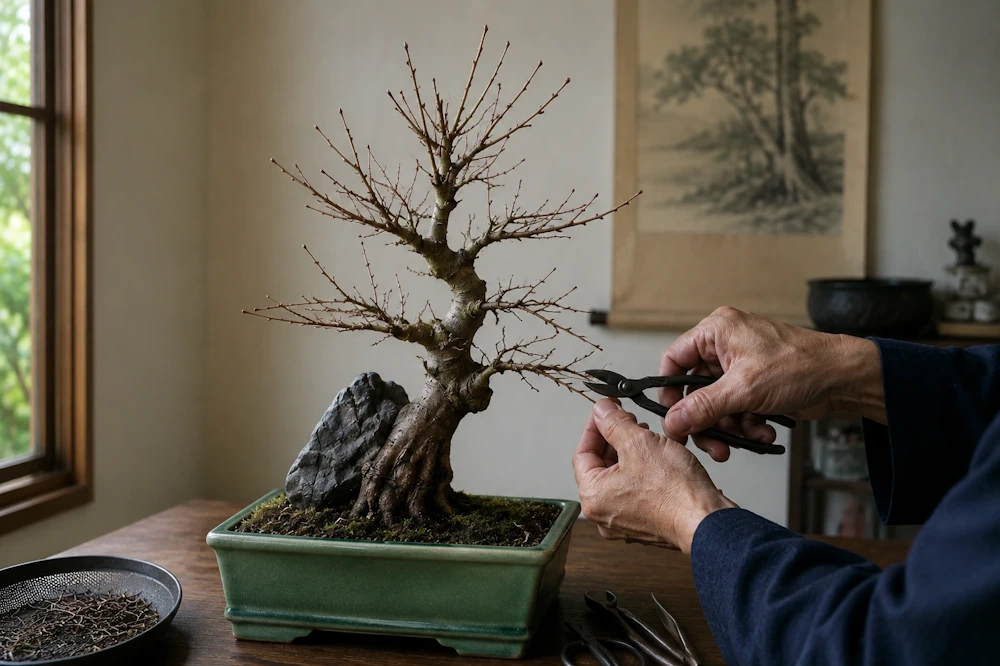
Bonsai ramification is the progressive division of branches into finer and finer twigs. It is the feature that separates a young tree with basic structure from a mature bonsai with dense foliage pads and a detailed winter silhouette.
You build it through repeated pruning, controlled growth, and patience over several seasons.
Basic branch structure forms the framework of your tree. It includes:
This stage defines height, movement, and balance. It answers the question: What is the overall design?
Bonsai ramification begins after this framework exists. It focuses on tertiary, quaternary, and finer twigging that develop from those primary and secondary limbs. Each subdivision creates smaller offshoots, which in turn divide again.
The result is:
When people ask, what is ramification in bonsai, and how do you build it, the answer is simple: you repeatedly cut back to two buds and guide the new shoots. The core technique section below covers exactly how to apply this.
Without ramification, your bonsai looks young and sparse. With it, the tree gains visual age and depth.
Ramification follows simple branching mathematics.
If you prune one shoot back to two buds, you now have two shoots. Prune those two back to two buds each, and you get four. Repeat the process and the number of tips doubles again.
This exponential increase in fine twig density cannot happen in a single growing season. It requires:
Each cycle strengthens your bonsai branch structure development. However, trees need time to recover and push new growth before you cut again.
Fine branching builds gradually. Some species respond faster, especially those that bud back readily. Others take longer but follow the same principle.
Ramification is not a one-time technique. It is a long-term process applied consistently over multiple seasons.
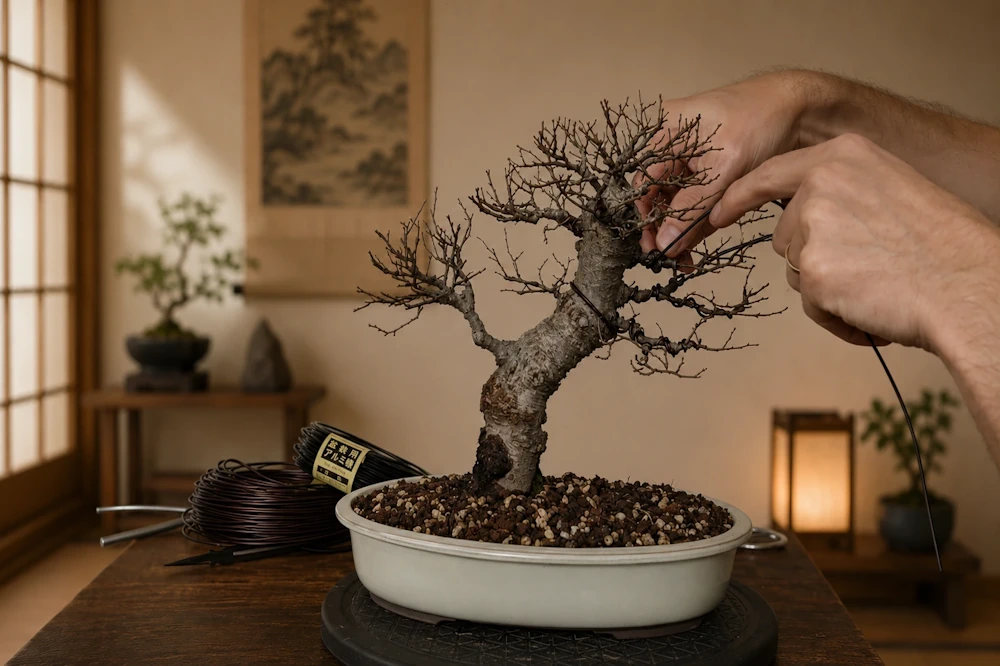
Late summer gives you clarity. Growth slows, structure becomes visible, and you can make precise decisions that shape next year’s branching. When you understand bonsai ramification timing, this period becomes one of the most strategic points in the year.
In spring and early summer, your tree pushes strong extension growth. Shoots lengthen quickly, internodes stretch, and fresh leaves hide the inner branch structure.
At that stage, it is hard to judge true ramification. You see movement and energy, but not balance.
By late summer, extension growth has largely hardened off. The tree shifts from rapid expansion to consolidation. This slower pace allows you to:
Foliage still sits on the tree, so you can evaluate density before autumn leaf drop on deciduous species. You see the full picture of what this season actually produced.
For bonsai ramification late summer work, this honest view matters. You assess what developed, not what you hoped would develop.
Spring pruning drives growth. You cut to redirect energy and stimulate fresh extension.
Late summer pruning does something different. You refine and select rather than stimulate.
In spring you might cut back to two buds to force new shoots. In late summer, you review the shoots that already formed and decide which ones deserve to stay. Your focus shifts to:
You do not prune in late summer expecting a strong second flush. Instead, you shape structure and stabilise energy distribution before dormancy.
This difference in intent defines why late summer ramification differs from spring pruning. Spring builds. Late summer edits.
Every bud you leave in late summer becomes a potential growing point next spring. Their position determines direction, taper, and pad density.
When you shorten a shoot to a specific outward facing bud, you choose the angle of next year’s branch. When you remove a strong upward bud, you prevent unwanted vertical growth before it begins.
Late summer ramification work sets up:
If you wait until spring to make these choices, the tree has already committed energy to unwanted buds. By selecting in late summer, you guide dormant buds through winter and enter spring with a clear structural plan.
You shape next year’s ramification before the buds even open.
Strong ramification comes from repeated, precise actions applied over several growing seasons. You build density by cutting back to two buds, pinching at the right time, maintaining clear branch hierarchy, and removing growth that competes for space and energy.
If you learn only one of the core bonsai ramification techniques, make it this one.
Each time a shoot extends, cut it back so that only two healthy buds remain at the tip. In simple terms, one growing point becomes two. Apply this across multiple seasons and you create an exponential increase in twig density, which drives fine bonsai twig development.
Make your cut:
Avoid leaving long stubs. They die back and spoil clean lines.
Use this method during active growth, especially on deciduous species such as Japanese maple or Chinese elm. Consistency matters more than intensity. Repeating this cycle year after year builds reliable bonsai secondary branching and gradually shortens internodes.
Pinching works best when you act early.
When a new shoot has formed 3 to 5 leaves but is still soft, pinch the tip between your fingers or trim it lightly with fine scissors. This keeps energy inside the existing branch structure and stimulates lateral buds to open.
Understand the intent:
For bonsai ramification pinching, timing is critical. If you wait until the shoot hardens, the tree has already invested energy in length rather than density.
Repeat pinching every 2 to 4 weeks during peak growth on vigorous deciduous trees. On conifers, adjust the method to candle pinching rather than leaf pinching. The goal stays the same: redirect energy into secondary branching instead of extension.
Ramified bonsai follow a clear hierarchy.
Your primary branches are thick and structural. From these grow secondary branches, and from those come tertiary shoots and fine twigs. Each level must be progressively thinner and shorter than the one before it.
Keep this structure clear:
| Level | Thickness | Role |
|---|---|---|
| Primary | Thickest | Main structure |
| Secondary | Medium | Sub-structure |
| Tertiary | Fine | Pad formation and detail |
If a tertiary shoot thickens too much, cut it back hard. If a secondary branch grows stronger than the primary above it, reduce it.
You manage hierarchy by balancing strength. Let weaker inner branches extend slightly longer before pruning. Cut strong outer tips earlier. This control of growth rate is central to building bonsai ramification without losing structure.
Encouraging new buds is only half the work. You must also remove what does not serve the design.
When two shoots grow from the same point and head into the same space, choose the better one and remove the other. Competing shoots divide energy and create swelling at the junction.
Remove growth that:
Clear branch lines improve light penetration. Better light encourages back budding and stronger bonsai secondary branching deeper in the tree.
Structure and clarity support long-term ramifications. When each branch has its own defined space, your bonsai ramification pruning produces finer, more controlled twig development year after year.
Before you try to develop bonsai ramification, you need to know where your tree currently stands. The structure you see today determines whether you should build framework, push density, or focus on bonsai branch refinement.
At the early stage, your bonsai usually has a trunk with a few main branches and perhaps one extra split on each. You can clearly see long, straight sections with wide gaps between forks.
You are not yet working on fine twig structure. Your priority is to establish:
Focus on structural pruning and wiring. Select 3 to 7 primary branches, depending on style and remove crossing or inward growth.
Avoid frequent pinching or defoliation at this stage. If you ask, how do I develop fine branching on my bonsai, the honest answer is that fine branching comes later. First, build the skeleton. Strong roots and balanced feeding matter more than detail work right now.
If your bonsai is not developing fine branching, it may simply be too early in development.
An intermediate tree has clear primary and secondary branches. You start to see smaller offshoots forming from those secondary branches.
Now consistency becomes more important than any single cut. Your main tool is selective pruning back to two buds or two leaves during the growing season.
This technique:
Apply it every growth cycle. Over 1 to 3 growing seasons, you should notice visible density increase on deciduous species.
If you skip pruning for one season, branches thicken and lengthen. That slows bonsai branch refinement. Regular light pruning works better than occasional heavy cutting.
You are building tertiary branching here. Do not rush into aggressive defoliation unless the tree is strong and healthy.
An advanced bonsai shows multiple levels of fine branching. You see short internodes, compact pads, and a dense network of twigs.
At this stage, maintaining ramification is as important as building it. Trees naturally try to revert to coarse growth through apical dominance.
Your focus shifts to:
You no longer make large structural cuts often. Instead, you preserve fine structure.
If your bonsai is not developing fine branching at this level, check light exposure, root health, and fertiliser balance. Weak growth rarely ramifies well. Healthy roots support fine twig development.
Good ramification depends on correct selection. Every branch should justify its place.
Assess each branch using four criteria:
| Criteria | What to Look For |
|---|---|
| Position | Does it fill empty space without crowding? |
| Angle | Around 45 to 60 degrees is usually ideal |
| Thickness | Each level should be thinner than the branch below |
| Silhouette | Does it improve the outline from all viewing angles? |
Remove branches that:
Develop branches that improve taper and create natural spacing. When in doubt, prioritise structure over density.
Clear selection decisions answer the question of how to identify which branches to develop and remove. Strong structure makes fine ramification possible.
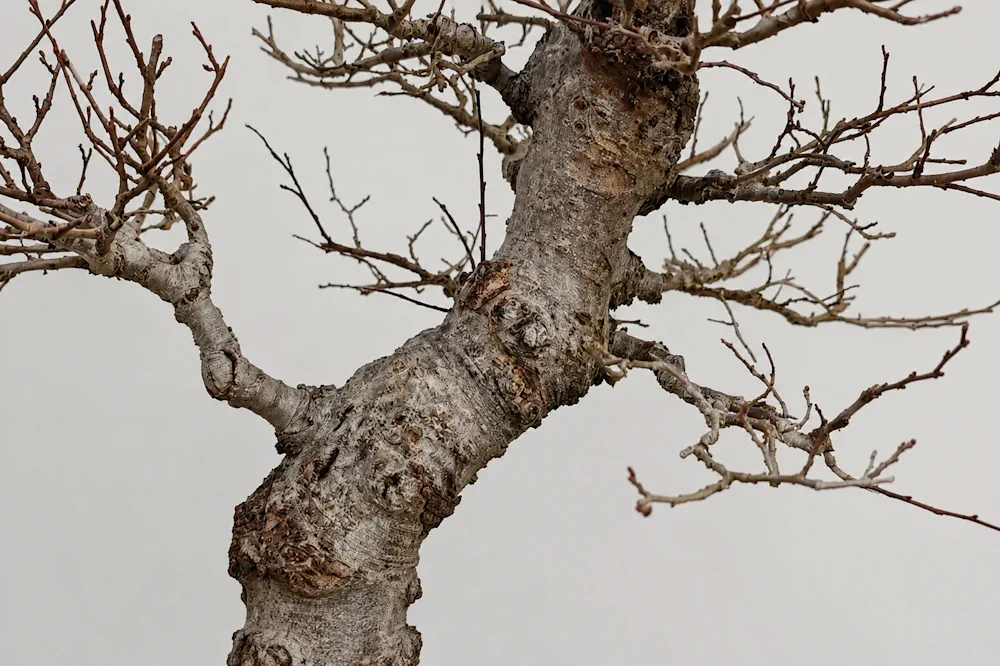
Different bonsai ramification species respond at very different speeds. Your technique, timing, and patience must match the tree in front of you if you want to develop bonsai ramification efficiently and safely.
If you ask which bonsai species develop ramification fastest, Chinese elm often tops the list. It responds quickly to pruning and back-buds reliably, even on older wood.
Use the classic two-bud pruning method:
Each cycle doubles the branching. You see visible density within 2 to 3 growing seasons of consistent work.
Chinese elm also tolerates partial or full defoliation when strong. That forces smaller leaves and tighter internodes. For beginners learning bonsai ramification, this species gives fast feedback and clear results.
Japanese maple and trident maple both respond well to two-bud pruning, but they behave differently. Trident maple grows faster and handles stronger pruning. Japanese maple is slightly more sensitive and needs more careful energy control.
With both species:
Trident maple can produce convincing fine ramification in 2 to 4 seasons. Japanese maple often takes a little longer, especially if you prioritise leaf size reduction at the same time.
Assess structure in autumn and winter when the leaves fall. The bare silhouette reveals flaws in taper and branch placement. Regular winter evaluation helps you refine structure year by year.
Beech and hornbeam develop some of the most refined twig structures in temperate bonsai, but they demand patience. Both grow more slowly than elm or trident maple, though hornbeam back-buds more readily and responds faster to pinching, which is why it rates slightly higher for ramification potential. Beech is the slower of the two and does not back-bud as aggressively on older wood.
Focus on:
You often need 5 or more growing seasons to build mature ramification. Progress feels slow at first, yet the natural fine twigging of these species rewards steady work.
Avoid over-pruning. Strong cuts can cause dieback or long coarse extensions. Instead, build density gradually and protect inner buds by maintaining light penetration.
Conifers require a completely different strategy. The idea of pruning back to two buds does not apply in the same way.
For juniper, you build ramification by managing foliage pads:
You shape masses of foliage rather than individual twigs. Dense pads can take 3 to 5 years of steady refinement.
For pine, focus on candle management:
Realistic timelines for pine ramification range from 3 to 7 years, depending on species and vigour.
Ficus and other indoor tropical species grow whenever conditions stay warm and bright. That allows you to work on ramification almost year-round.
Use a simple cycle:
In strong light, you can develop visible fine branching within 1 to 3 years.
Indoor species do not experience a full winter reset. Because of that, you must manage energy carefully. Rotate the tree, ensure even light, and avoid letting one apex dominate.
Consistency matters more than intensity. With steady pruning and good light, tropical species can develop dense, controlled ramification surprisingly quickly.
Many problems with bonsai ramification come from doing too much, too fast, or in the wrong place. You improve fine branching by managing energy, pruning with intent, and working in stages rather than forcing quick results.
When you try to build bonsai ramification, it is tempting to cut hard in one session. You remove long shoots, thin crowded areas, and reduce height all at once.
That often sets development back.
Heavy pruning removes stored carbohydrates in leaves and shoots. It also removes dormant buds along inner branches, which would have produced the next level of fine twig structure. You lose both energy and future options.
Follow the one-third rule:
Staged pruning keeps the tree strong and preserves interior growth. If you are asking, why is my bonsai not developing fine branching?, check whether you repeatedly strip it back too hard. Controlled, repeated refinement builds structure faster than drastic resets.
Apical dominance works against balanced bonsai branch refinement. The strongest shoot in any area produces hormones that suppress weaker nearby shoots.
If you leave one branch unchecked, it will thicken and extend while others stall.
You correct this by actively balancing vigour:
In practice, this means cutting the top and outer tips first. Delay pruning on inner or lower branches until they gain strength.
Think in terms of energy control. You are not just shaping wood. You are directing growth. When you equalise vigour across the structure, you create even, layered ramification instead of one coarse branch and several weak ones.
Dense growth is not the same as true ramification. A tight mass of shoots can look full, but it often hides poor structure underneath.
Real bonsai ramification shows:
If you allow every shoot to remain, branches cross and shade each other. Shaded buds weaken and die. The result is fewer usable inner shoots, not more.
Selective pruning works better than keeping everything. Choose:
Remove the rest early. Fewer, well-placed shoots produce finer twigging than a crowded cluster competing for light. Quality always builds better ramification than raw density.
Fine ramification takes time. On most species, you need at least three to five growing seasons of consistent technique to see mature twig structure. Conifers may take longer.
When progress feels slow, you may respond with heavier pruning, full defoliation, or repeated drastic cuts. This is where expecting too much too soon bonsai ramification becomes a real problem.
Each severe intervention can reset development by:
Instead, measure progress in small steps. Shorter internodes this year. More back budding next year. Finer subdivision after that.
You build bonsai ramification through repetition and patience. Consistency over several seasons produces refined branching. Sudden force rarely does.
Strong bonsai ramification develops over several growing seasons, not in a single year. You build structure first, then density, and finally learn how to maintain fine branching without letting the tree revert to coarse growth.
In your first focused season, you set the foundation. You will not create a fully ramified canopy yet, but you can build the framework that makes it possible.
Start with clear primary branch selection. Remove crossing, bar branches, and any shoots that emerge from the inside of curves. Fix structural flaws now, because they only become harder to correct later.
Next, begin developing secondary branching on each primary branch. During active growth, apply the two-bud pruning method covered in the core techniques section, encourage back budding close to the trunk, and wire young secondaries into usable positions.
You should also learn your tree’s growth cycle. Deciduous trees often respond well to spring pruning and summer pinching, while many conifers require more careful timing.
At the end of year one, you want:
This stage usually takes one full growing season, sometimes two for slower species.
Years two and three focus on density and refinement. This is where you begin to visibly develop bonsai ramification.
You now build tertiary branching on established secondary branches. Prune repeatedly during the active season to stimulate back budding and shorten internodes.
Key actions include:
You should begin to see the early formation of foliage pads on suitable species. Pads form when repeated pruning creates multiple fine shoots from one point.
Expect gradual progress. For many deciduous species, it takes three to five years to achieve convincing fine ramification. Faster growers respond sooner, slower species require patience.
By the end of year three, you want:
Maintaining ramification requires a shift in mindset. You stop building coarse structure and start preserving fine detail.
Use lighter but regular pruning. Do not allow shoots to extend unchecked, as this causes internodes to lengthen and branches to thicken.
During the growing season:
Some branches will naturally try to thicken and overtake weaker areas. Reduce them promptly to keep balance across the canopy.
Each year, assess:
Ramification never stays finished. You maintain it through steady seasonal work.
Developing true bonsai ramification often takes several years of consistent effort. That long-term process is not a drawback. It is the ongoing engagement with a living tree that makes bonsai such a rewarding horticultural practice.
You build bonsai ramification by repeating simple actions at the right time for each species. Some trees respond fast, others demand patience.
If you ask which bonsai species develop ramification fastest, Chinese elm, trident maple and ficus usually lead under UK conditions. Pines and beech take longer but reward steady work.
Use this table as a direct guide to how to build bonsai ramification by species.
| Species | Ramification Potential | Primary Technique for Building Ramification | Visible Fine Branching (UK) | Key Mistake to Avoid |
|---|---|---|---|---|
| Chinese Elm | High | Frequent pinching + partial defoliation | 1 to 3 seasons | Letting shoots run too long |
| Trident Maple | High | Clip and grow + full defoliation on strong trees | 1 to 3 seasons | Defoliating weak trees |
| Japanese Maple | High | Pinch to 1 to 2 leaves + selective defoliation | 2 to 4 seasons | Ignoring apical dominance |
| Beech | Medium | Light pruning + careful pinching | 3 to 5 seasons | Heavy pruning on old wood |
| Hornbeam | Medium to High | Clip and grow + summer pinching | 2 to 4 seasons | Overcrowded inner growth |
| Juniper | Medium | Repeated tip pinching + wiring for light | 3 to 5 seasons | Shearing instead of selective pinching |
| Japanese Black Pine | Low to Medium | Candle cutting + autumn needle pluck | 3 to 7 seasons | Cutting all candles equally |
| Ficus | High | Year round pinching in warm growth | 1 to 2 seasons | Poor light levels |
Ramification defines mature bonsai. You create it through consistent, correct bonsai ramification techniques applied over multiple seasons, not through complex interventions.
Late summer gives you a clear view of structure because growth has hardened and you can assess progress accurately. Growers who achieve the finest ramification apply the right basic technique every year, not occasionally.
Start by identifying your development stage, not by reaching for scissors. A grower at the early stage who begins pinching and defoliating achieves nothing useful, because the framework that ramification builds on does not yet exist. A grower at the advanced stage who attempts heavy structural cuts destroys years of fine work. The correct technique depends entirely on where the tree is now, not on what the most impressive technique looks like.
In our experience, the growers who develop the finest ramification are not those who work hardest in any single season. They are the ones who apply the two-bud rule consistently, season after season, without skipping cycles or resorting to heavy intervention when progress feels slow. The mathematics of doubling is patient. Two becomes four, four becomes eight. Given enough consistent seasons, even a modest start produces a refined canopy. The challenge is not knowing the technique. It is trusting it long enough for it to work.
Miyagi Bonsai stocks a carefully chosen range of bonsai trees suited to development and refinement, including strong ramification species such as Chinese Elm, Trident Maple and Ficus, with next working day UK delivery available on most orders. The products and recommendations in this guide reflect what we stock, use and see working for our customers every day. We are rated 5 stars across over 100 Google reviews, and our team is on hand by email and phone if you have any questions about ramification technique or species selection.
On responsive species like Chinese elm, visible ramification can begin developing within two to three growing seasons of consistent technique. On slower species like beech or Japanese maple, five or more seasons of patient work are more realistic for genuinely fine structure. The timeline depends less on the techniques used and more on the consistency with which they are applied; growers who apply correct technique every growing season without skipping years or reverting to heavy intervention produce the best results regardless of species.
The most common reason is insufficient light reaching inner branch sections; dormant buds on inner wood require a minimum light threshold to activate, and a dense outer canopy that shades inner sections prevents fine branching from developing there, regardless of pruning technique. The second most common reason is pruning too heavily in single sessions, which removes the buds that would have become the next level of fine twig structure. Thin the outer canopy to improve light penetration, apply the two-bud pruning technique consistently rather than heavy periodic cutting, and allow at least one full growing season for the response to become visible.
Defoliation can accelerate ramification on suitable species, but only when used correctly. Removing leaves reduces auxin at shoot tips, allowing light and energy to reach dormant inner buds. On a healthy tree, this triggers back budding on older wood and produces smaller leaves on the new flush, both of which improve fine ramification. It is only reliable on deciduous species such as Chinese Elm, Trident Maple, and Japanese Maple. Apply it only after the first spring flush has fully hardened and only on strong, healthy trees with good root systems. Avoid defoliating weak or recently stressed trees, as it can cause dieback. Never use it on conifers, and do not defoliate trees that have been recently repotted, heavily wired, or show signs of stress.
Yes, ramification can be developed on a bought bonsai that already has basic structure. Many commercially available trees in the UK have primary branches in place but lack secondary and tertiary development. If the primary branches are well positioned with good spacing, angles, and taper, you can begin ramification immediately using the two-bud pruning cycle. Start by removing any branches that cross, grow inward, or create structural issues, as correcting these later is much harder. Once the framework is clean, begin the pruning cycle in the first full growing season. On responsive species, noticeable density improvement can be seen within two to three seasons. If the tree has structural flaws such as bar branches, poor taper, or dominant crossing branches, correct those first before focusing on fine branching.

