
You achieve stronger autumn colour in your maple bonsai by giving it bright light, steady moisture, and balanced feeding while easing back on nitrogen as growth slows.
Cool nights and sunny days intensify pigment, but stress from drought, harsh wind, or poor drainage can dull the display and damage delicate leaves.
Autumn transforms your Japanese maple bonsai into the focal point of your garden or patio. As temperatures cool, Acer palmatum shifts from summer green to shades of red, orange, and gold, with some cultivars showing multiple tones on one tree. You do not just watch the change. You guide it.
As leaves fall, your Japanese maple bonsai enters dormancy. This stage sets up next year’s growth. When you adjust watering, protect roots from severe frost, and avoid heavy pruning, you protect both colour and long-term health.
This guide draws on established UK bonsai practice and is written for growers managing Japanese maple in British growing conditions. Whether you are experiencing your first autumn with an Acer palmatum bonsai or refining care across several cultivars, the guidance here applies across experience levels.
Autumn defines the Japanese maple bonsai experience. This is when months of careful watering, feeding and pruning translate into intense colour, clean leaf fall and proper dormancy.
Japanese maple bonsai autumn colour stands apart from most deciduous species. Whether you are growing your first maple or comparing results across several cultivars, you often see deep red, crimson, orange and golden yellow on the same tree at once.
This distinctive display comes from the way Acer palmatum reduces chlorophyll as daylight shortens. As green fades, red and orange pigments become visible. Some cultivars produce especially strong crimson tones, while others lean towards amber or bright orange.
One tree can show multiple shades at the same time. The outer canopy may turn red first, while inner leaves stay yellow or green for longer. This staggered change creates depth and contrast that few other common bonsai species match.
In the UK climate, cool nights in September and October often intensify colour. When you manage watering and light correctly, you achieve clearer tones and more even change across the canopy.
For a broader look at species known for strong seasonal display, see the autumn colour guide.
Japanese maple demands more attention in autumn than many other bonsai. It reacts quickly to mistakes made in late summer and early autumn.
Common errors include:
Late nitrogen feeding often reduces colour intensity and delays dormancy. Incorrect positioning can cause leaf scorch during warm September days, especially if temperatures rise above 25°C.
In Acer bonsai autumn UK conditions, sudden temperature drops are common. You must balance light exposure with frost awareness. Move the tree to a sheltered spot once hard frost threatens, but avoid bringing it indoors.
When you follow species specific care rather than generic autumn advice, you get:
For timing details, refer to the dormancy timing post.
Understanding what to expect through September, October and November helps you act at the right time.
September marks the onset of colour change.
You reduce or stop nitrogen feeding, maintain steady watering, and ensure good light. Nights begin to cool, and early reds or yellows appear at the canopy edges.
October usually brings peak colour in much of the UK.
You see full red, orange or gold across the tree. Leaf drop begins towards the end of the month. Remove fallen leaves from the soil surface to reduce fungal risk.
November signals full dormancy.
Most or all leaves have fallen. You protect the roots from severe frost and prepare for winter. At this stage, energy has moved back into the roots and branches, setting the foundation for strong spring growth.
By tracking these monthly shifts, you can respond to your Japanese maple bonsai autumn needs with more confidence than guesswork alone allows.
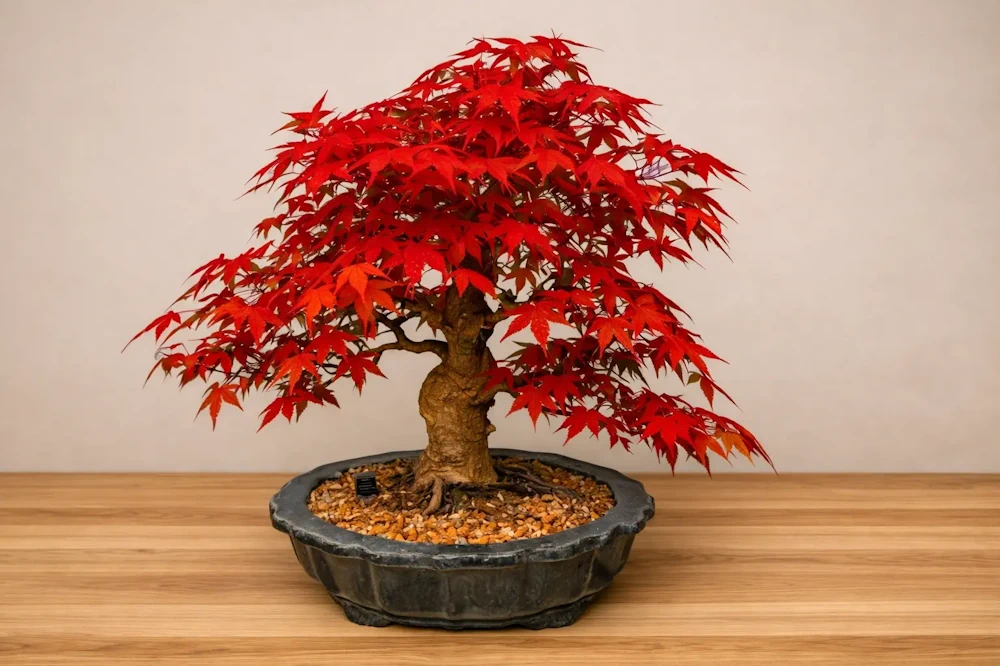
Japanese maple bonsai autumn colour follows a clear pattern each year, shaped by temperature, light, and variety. When you understand the colour progression from green through red to drop and adjust your growing conditions, you can noticeably improve both intensity and duration.
Your Japanese maple bonsai colour change usually begins in early to mid September in most UK regions. The first signs appear at the outer canopy and leaf margins, where exposure to light and cooler air is greatest.
As nights cool, chlorophyll breaks down and reveals yellow and orange carotenoids. At the same time, cool nights below about 7°C encourage anthocyanin production, which creates red and crimson tones.
Through October, colour deepens and moves inward. Peak intensity often arrives in mid to late October, depending on your local climate and exposure.
The full display typically lasts two to four weeks. Wind, heavy rain, or sudden frost can shorten it. As colour fades, the leaf stem weakens and leaves drop naturally, signalling dormancy.
Not all Japanese maple bonsai produce the same autumn display. Autumn colour varies widely between cultivars, even when grown in identical conditions.
If you want reliable deep crimson or scarlet, look for:
For strong orange and gold tones, consider:
When selecting a new tree, check:
Japanese maples are described as highly variable, and that applies strongly to autumn colour. Choose specifically for autumn potential if that is your priority.
Light and temperature drive Japanese maple bonsai colour intensity in autumn more than feeding or pruning.
For the strongest reds and oranges, aim for:
Sunlight is the single most important factor you control. Position your bonsai where it receives strong autumn light rather than deep shade.
Avoid placing it in a sheltered corner that stays warm overnight. A location with a greater day-to-night temperature difference encourages stronger anthocyanin production and deeper red tones.
Reduce nitrogen feeding from late summer onwards. High nitrogen encourages prolonged green growth and can delay or dull colour change.
You will notice that the Japanese maple bonsai colour change varies from year to year.
Mild, cloudy autumns with consistently warm nights produce:
Exceptional colour years usually follow a pattern of bright days and cool or lightly frosty nights. These classic continental conditions create high sugar levels in leaves and trigger strong pigment production.
Extended rain or early storms can shorten the display by knocking leaves off before peak colour. Even with perfect care, weather patterns largely determine whether your bonsai delivers a good year or an outstanding one.
Autumn feeding for a Japanese maple bonsai is about restraint and timing. You reduce nitrogen early, apply one final low nitrogen feed in late summer, then stop completely before colour change begins.
Japanese maple bonsai autumn feeding requires stricter timing than many other temperate species. Japanese maples are especially sensitive to late nitrogen.
Stop high nitrogen feeding by late July or very early August at the latest. Do this earlier than you would for many other deciduous bonsai.
Late nitrogen pushes soft, fast growth. After early August, this growth does not harden properly before cold weather. You will notice:
The first frost often kills these unripened tips. You then face dieback and extra pruning in spring.
If you are wondering when to stop high nitrogen feeding maple, use this rule: once summer heat peaks and days begin to shorten, nitrogen-heavy fertiliser should already be off your schedule.
After stopping nitrogen, while optional, you can apply one final low nitrogen feed. Timing matters.
Apply this feed in August, before any visible autumn colour appears. Do not wait until leaves start turning red or orange.
Use a fertiliser with:
The exact numbers matter less than keeping nitrogen clearly lower than potassium.
This final low nitrogen feed timing and formula support:
It does not aim to produce new growth. Instead, it helps the tree mature existing tissue and prepare for dormancy. Apply at a light, controlled rate rather than heavy feeding. Remember, this is optional.
All feeding should stop before colour change begins, usually in September in the UK.
Once leaves start to shift colour, your tree is withdrawing nutrients from them. It is not trying to push new growth. Feeding during this phase is counterproductive.
Remember: If colour change has started, feeding should already have stopped.
Continuing to fertilise during autumn colour can confuse the growth cycle. It may delay dormancy and weaken winter readiness.
For Japanese maple bonsai autumn feeding, precise timing protects your tree. Stop early, finish lightly, and let the tree shut down naturally.
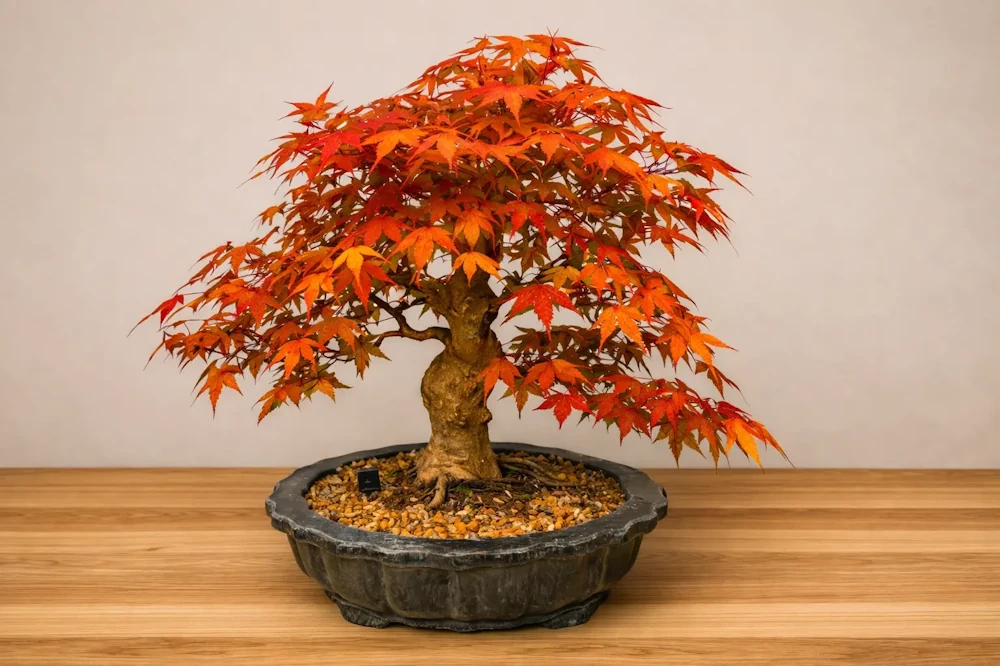
Japanese maple bonsai autumn watering requires steady adjustment, not routine summer habits. As temperatures drop and leaves change colour, your tree uses far less water, and the soil stays moist for longer.
In early autumn, your Japanese maple bonsai still carries full foliage. Leaves continue to transpire, so water demand remains moderate.
However, as colour change begins, active transpiration drops sharply. The leaf prepares for abscission, and the tree gradually reduces sap flow to each leaf. You will notice the soil dries more slowly than it did in August.
By mid to late October, especially in cooler parts of the UK, evaporation slows due to lower temperatures and weaker sunlight. At the same time, root activity begins to reduce as the tree approaches dormancy.
Instead of following a fixed schedule, check moisture directly:
Tracking soil drying speed week by week helps you match the tree’s changing needs. This approach prevents both under and over watering.
The risk of overwatering a maple in late autumn is real and common. Many growers continue summer watering frequency into October, which often keeps the root ball constantly moist.
Three factors combine to increase risk:
Because of this, soil can remain wet for several days longer than expected. Constant moisture limits oxygen around the roots. This increases the chance of fungal problems developing through winter.
In late October and November, soggy soil also cools more quickly overnight. Cold, wet roots are more vulnerable to rot and winter damage.
Japanese maple bonsai autumn watering should feel restrained. You are maintaining slight moisture, not keeping the compost continuously wet.
Watering frequency shifts gradually from September to November. Exact timing depends on climate, pot size, and soil mix, but the pattern is consistent.
Early September
Late September to Early October
Mid to Late October
November
This week-by-week approach keeps roots healthy while respecting how water demand changes through autumn.
Autumn is more about assessment than heavy cutting. Japanese maple bonsai autumn pruning requires restraint, careful observation, and a focus on winter preparation rather than reshaping.
Japanese maple is one of the bonsai species where autumn pruning restraint matters most. You should avoid structural cuts during this period, even if you clearly see design flaws.
Do not cut:
Maple bark is thin and sensitive. When you expose fresh tissue in autumn, cold and wet conditions can lead to die-back along the cut. A cut that would be minor on Chinese elm or juniper can cause serious damage on maple.
Healing slows as temperatures drop. For this reason, complete structural pruning should wait until full dormancy in late autumn, or better still, late winter or early spring when healing begins immediately. Patience protects branch health and prevents unnecessary loss.
So what is safe to remove before winter?
Keep it limited and purposeful. Only cut material that clearly threatens the tree’s health or structure through winter.
Safe removals include:
Even then, use sharp, clean tools. Make precise cuts that leave no torn bark. Seal larger wounds to reduce moisture entry and winter damage.
Japanese maple bonsai winter preparation should focus more on protection than shaping. Removing too much foliage before dormancy can weaken the tree. As a simple rule, if the branch can wait until spring without risk, leave it.
Autumn leaf drop gives you a clear view of your tree’s structure. Japanese maple sheds leaves cleanly, which makes this the best time to study branch hierarchy and ramification.
With the canopy gone, you can assess:
You cannot see these details clearly during summer growth.
Instead of cutting straight away, record your observations. Take photos from the front, sides, and above. Mark branches you plan to shorten in late winter.
Using autumn leaf drop to assess branch structure helps you make better decisions later. You enter spring pruning with a clear plan rather than reacting in the moment.
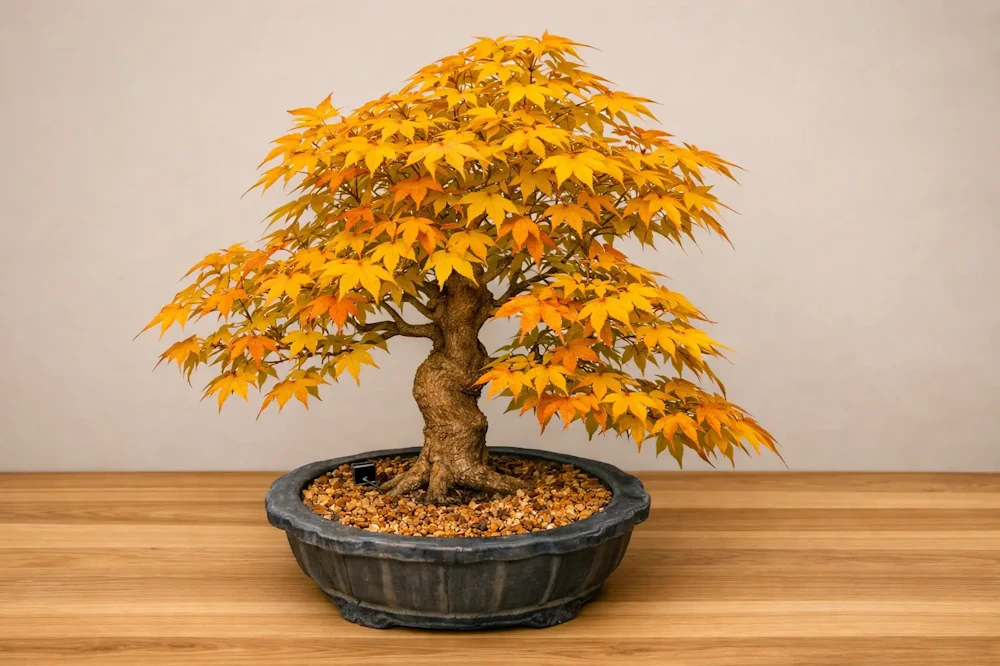
Autumn is a balancing act for your Japanese maple bonsai. You need enough light for strong colour, but also shelter from frost pockets and drying winds that can damage delicate foliage and fine twigs.
Where to position a Japanese maple through autumn affects both colour and health.
Place your bonsai in:
Good light in September and early October helps Acer palmatum bonsai develop intense red and orange tones. Red-leaved cultivars in particular need some direct sun to maintain rich colour.
At the same time, avoid exposed patios or rooftops. Strong wind dries the shallow root system and thin leaves quickly.
One critical point is frost pockets. Cold air sinks on still nights and settles in low spots. A bench just 30 to 60 cm higher can avoid several degrees of temperature drop. That small difference can prevent frost damage during sensitive weeks.
Japanese maple bonsai frost protection depends on timing, not just temperature.
Once fully dormant in mid-winter, a well-established bonsai can tolerate moderate frost to around -10°C in air temperature. At this stage, hardened wood and dormant buds cope well with cold in most parts of the UK.
The root zone in a shallow bonsai pot is more vulnerable than the above-ground structure; roots can suffer damage when pot temperatures drop below around -2°C, even when air temperature remains within the safe range for hardened wood. Insulating the pot or raising it off cold ground reduces this risk without disrupting dormancy.
The vulnerable period comes earlier.
During October, when leaves change colour and drop, tissues are not fully hardened. Even light frosts around -1°C to -3°C can:
In this transition phase, move your tree to a cold frame, unheated greenhouse, or against a sheltered wall overnight if frost is forecast. Once leaves have fallen and dormancy is complete, protection becomes less urgent until temperatures approach severe levels.
Wind protection is as important as frost for maple in autumn.
Japanese maple leaves are thin and lose moisture quickly. Dry autumn winds increase transpiration and can cause:
Wind also stresses fine branch tips. Repeated exposure can lead to dieback at the ends of delicate twigs.
Place your Acer palmatum bonsai where buildings, hedges, or fences block prevailing winds. A spot that still receives morning or early afternoon sun works well.
Check soil moisture more often in windy weather. Even cool days can dry a shallow bonsai pot quickly. By reducing wind exposure, you protect both the foliage display and the fine branch structure that defines your tree.
In autumn, your Japanese maple bonsai leaf drop should follow a clear seasonal pattern. The timing, colour change, and way the leaves fall all help you decide if what you see is healthy or a sign of stress.
In most UK regions, Japanese maple bonsai lose their leaves between late October and late November.
You usually see peak autumn colour first. Leaves turn red, orange, or yellow, then begin to dry and thin before they fall. In a typical year:
Cool nights and shorter days drive this process. A mild autumn can delay full leaf drop by a week or two.
Healthy drop follows a clear pattern:
Different cultivars vary slightly. Finely cut types often drop a little earlier than thicker leaved varieties, but the overall window in the UK stays within that late October to late November range.
Leaf drop signals a problem when you see:
Green leaf drop often points to shock. Common causes include overwatering, underwatering, root disturbance, or sudden temperature swings.
If only one area loses leaves, check for localised root issues in the pot or pest damage on specific branches. Spider mites and fungal leaf problems can weaken leaves before normal autumn.
Premature drop before October in the UK nearly always warrants inspection of watering habits, feeding levels, and root health.
By mid to late November, your Japanese maple bonsai should stand bare but structured.
Healthy winter branches look:
You should see small, tight buds already formed for next spring. They sit opposite each other along the twigs and feel solid when gently touched.
The canopy should not look patchy or dieback-ridden. A balanced outline, with fine twigging visible throughout, shows that autumn leaf drop followed its natural course.
When the structure looks tidy and the timing matches the normal UK window, your bonsai has entered dormancy exactly as it should.
Use this practical checklist for your Japanese maple bonsai autumn routine. Confirm each point with a clear yes before winter fully sets in.
This supports strong wood and steady Japanese maple bonsai dormancy.
In the UK climate, wet soil in cold weather risks root problems.
This suits Acer palmatum bonsai autumn UK conditions.
Complete this Japanese maple bonsai winter preparation through September and October and your tree enters dormancy in strong condition. A well managed Japanese maple rewards you with reliable autumn colour and a refined winter outline that stands beautifully even without leaves.
In our experience, the most common Japanese maple autumn mistake is leaving nitrogen feeding too late and then wondering why colour looks flat, or growth fails to harden before the first frost. The two things are directly connected. Stop high nitrogen by late July, apply one final low nitrogen feed in August, and let the tree respond to natural cooling and shortening days from September onwards. Position it where it gets direct autumn sun, shelter it from wind, and protect the roots once hard frost threatens. Do those things consistently each year, and the display looks after itself.
Miyagi Bonsai stocks a carefully chosen range of Japanese maple bonsai and autumn care supplies suited to UK growing conditions, including cultivars selected for strong autumn colour alongside low nitrogen autumn fertilisers and frost protection, with next working day UK delivery available on most orders. The products and recommendations in this guide reflect what we stock, use, and see working for our customers every day. We are rated 5 stars across over 100 Google reviews, and our team is on hand by email and phone if you have any questions about Japanese maple autumn care, cultivar selection, or preparing your maple for winter.
Brown rather than red autumn colour usually points to one of three causes. The most common is stress earlier in the season: drought during summer, overwatering, or root damage can all prevent the tree from building the sugar reserves that drive anthocyanin production. The second cause is late nitrogen feeding, which keeps leaves producing chlorophyll for longer and suppresses red pigment development. The third is insufficient light during the colour change period. Japanese maple needs direct autumn sun to intensify red tones. If the tree sat in shade through September and October, red pigments do not develop fully and colour shifts towards brown or dull yellow instead. Review watering consistency, feeding timing, and positioning from the following spring to improve next year’s display.
Yes, but with care and only at the right stage. The best window is after leaf drop, when branches are fully visible, and the tree is entering dormancy. At this point, you can see the branch structure clearly, and growth has stopped, which reduces the risk of wire cutting into bark quickly. Avoid wiring while leaves are still changing colour; the bark is thin and marks easily at this stage. Use aluminium wire rather than copper, apply it loosely, and check every two to three weeks through winter. Remove it before buds begin to swell in late winter or early spring, as maple bark scars permanently if wire bites during the first flush of growth.

